


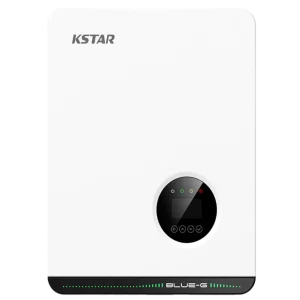
The KSTAR BlueSpark three-phase residential ESS is a complete all-in-one home energy storage system for three-phase EAC connections. Hybrid inverter and stackable battery modules in a single unit — choose the inverter (8, 10 or 12 kW) and the battery size (1 to 8 modules of 5.12 kWh LFP). CATL or EVE cells, 5-year product / 10-year performance warranty, IP66 outdoor-rated, certified to EN 50549, VDE 4105 and C10/C11 European grid codes. Supplied across Cyprus by CGP Solar.
✓ VAT included · Delivery in Cyprus
What It Is
The price on this page is for the KSTAR BlueSpark three-phase hybrid inverter unit (E8KT-D22, E10KT-D22 or E12KT-D22). The stackable battery modules (KSTAR BluE-Pack 5.1, 5.12 kWh each) must be purchased separately and added to your configuration. Buy the KSTAR BluE-Pack 5.1 battery module here →
The KSTAR BlueSpark three-phase residential ESS is a complete all-in-one home energy storage system for three-phase EAC connections: hybrid inverter and lithium iron phosphate (LFP) battery modules in a single stackable tower. Choose the inverter (8, 10 or 12 kW) and the battery size (from 1 to 8 modules of 5.12 kWh each), and CGP Solar delivers it as one factory-built system — no separate cabinets, no third-party battery integration, no field-engineered control system. The KSTAR BlueSpark three-phase residential ESS is designed to install on a single wall or floor footprint in a garage, utility room or sheltered outdoor space.
The KSTAR BlueSpark three-phase residential ESS pairs the inverter with KSTAR’s own battery management system (BMS) and energy management system (EMS) — both factory integrated, configurable from a smartphone, and connected to KSTAR’s cloud platform for 24/7 monitoring. Total system capacity scales from 5.12 kWh to 40.96 kWh in 5.12 kWh steps, so the same product line covers everything from a small apartment to a large villa with heat pump, EV charger and high evening demand.
Cell Manufacturer
Powered by CATL and EVE — both Tier-1 cell brands
KSTAR officially supplies the BlueSpark Residential ESS with cells from CATL (the world’s largest battery cell producer) or EVE Energy (one of the top global LFP suppliers), and prints both names directly on the datasheet. CATL and EVE are the same cell brands powering utility-scale storage projects worldwide. Buying the KSTAR BlueSpark three-phase residential ESS means the cells inside the cabinet are not white-label or rebadged — this is unusual transparency for a residential battery product.
The KSTAR BlueSpark three-phase residential ESS hybrid inverter is rated IP66 — the highest practical IP rating for outdoor equipment, dustproof and water-jet protected. The battery modules are rated IP65. The system is designed to live in a garage, utility room or sheltered outdoor wall location. Operating temperature is −25 °C to +60 °C with derating above 40 °C, so the system performs across Cyprus’s full climate range without enclosure modifications.
The KSTAR BlueSpark three-phase residential ESS uses KSTAR’s integrated BMS and EMS. The system supports four operating modes out of the box: self-consumption, peak shaving, time-of-use, and battery priority. Modes are configured during commissioning via Bluetooth from a smartphone, then monitored from the KSTAR cloud app or web portal. Communication uses RS485, CAN 2.0 and WIFI — keeping the system compatible with third-party home-management systems where needed.
See It In Action
KSTAR has published a short product video walking through the BlueSpark Series — the cabinet, the inverter, key specifications and design features. Worth two minutes if you want a manufacturer-led overview before going deeper into the datasheet.
For full manufacturer specifications, certifications, and the official KSTAR product brochure, visit the official KSTAR BlueSpark Series 4–12 kW Three-Phase Residential ESS product page:
Who This Is For
The KSTAR BlueSpark three-phase residential ESS is the right choice for these Cyprus home profiles:
Why It Stands Out
The features below are KSTAR’s official specifications for the BlueSpark three-phase residential ESS 8–12 kW range. No marketing inflation, no estimated figures.
The KSTAR BlueSpark three-phase residential ESS hybrid inverter achieves up to 97.2% maximum PV efficiency across the 8/10/12 kW range. Euro-weighted efficiency (the more realistic measure for European climates) is up to 95.5%. The inverter is transformerless with a wide MPPT voltage range of 140–950 V DC, giving flexibility on string sizing.
Unusually for a residential inverter, the KSTAR BlueSpark three-phase residential ESS supports 100% three-phase unbalanced output. That means the inverter can put 100% of its power onto any single phase if that’s where the load is — typical Cyprus homes are not perfectly balanced across L1, L2 and L3, so this feature recovers significant capacity that a balanced-only inverter would leave on the table.
The KSTAR BlueSpark three-phase residential ESS supports a DC/AC ratio of up to 2, meaning an 8 kW inverter can take up to 16 kWp of PV, a 10 kW inverter can take 20 kWp, and the 12 kW inverter can take 22 kWp. Oversizing the PV array against the inverter is the standard way to push more annual energy through a hybrid system, and 2.0 is the maximum ratio in the residential market.
The KSTAR BlueSpark three-phase residential ESS is engineered as a vertical stack: inverter on top, battery modules below, all connected by integrated busbars. No power wiring between modules, no communication cabling, no separate cabinet for the battery system. Installation footprint is just the base of the tower — typically 725 × 418 mm for the battery and 725 × 490 mm for the inverter.
Each battery module in the KSTAR BlueSpark three-phase residential ESS is 5.12 kWh total energy with a usable capacity of 4.6 kWh (90% usable, the residential industry standard). The cells are rated for 100% maximum DoD with 5.12 kWh tested at 25 °C, 0.5C charge/discharge at the beginning of life. Battery pack round-trip efficiency is > 94%. Modules connect up to a maximum of 8 per system = 40.96 kWh total.
The KSTAR BlueSpark three-phase residential ESS works in three different installation topologies depending on whether you already have solar panels, a separate PV inverter, or are starting from scratch. All three setups share the same connection points: a CT (current transformer) clamp on the grid feed for self-consumption metering, a connection to normal household loads, and a separate backup-loads circuit that stays powered when the grid drops. The system is monitored via a LAN connection to KSTAR’s cloud and your monitoring device.
Topology 1 · New Install
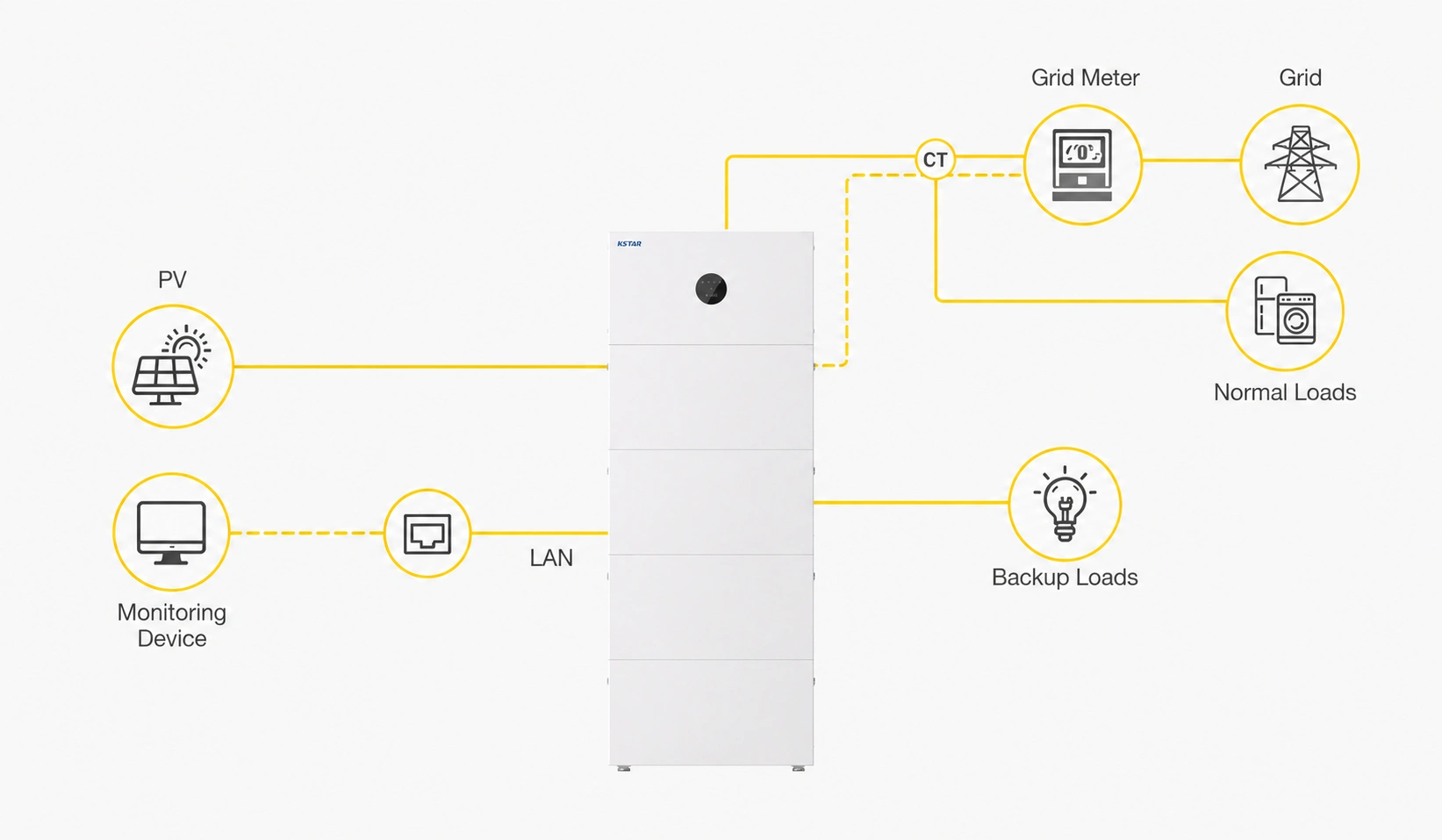
The simplest setup, and the recommended one for new installations. Solar panels feed DC straight into the BlueSpark’s built-in MPPT trackers — no separate PV inverter needed. The BlueSpark handles PV-to-AC conversion, battery charging/discharging, and the on/off-grid switching all in one unit.
Topology 2 · Expansion
For expanding an existing solar system. The original PV inverter stays in place; additional new panels go directly into the BlueSpark’s MPPTs.
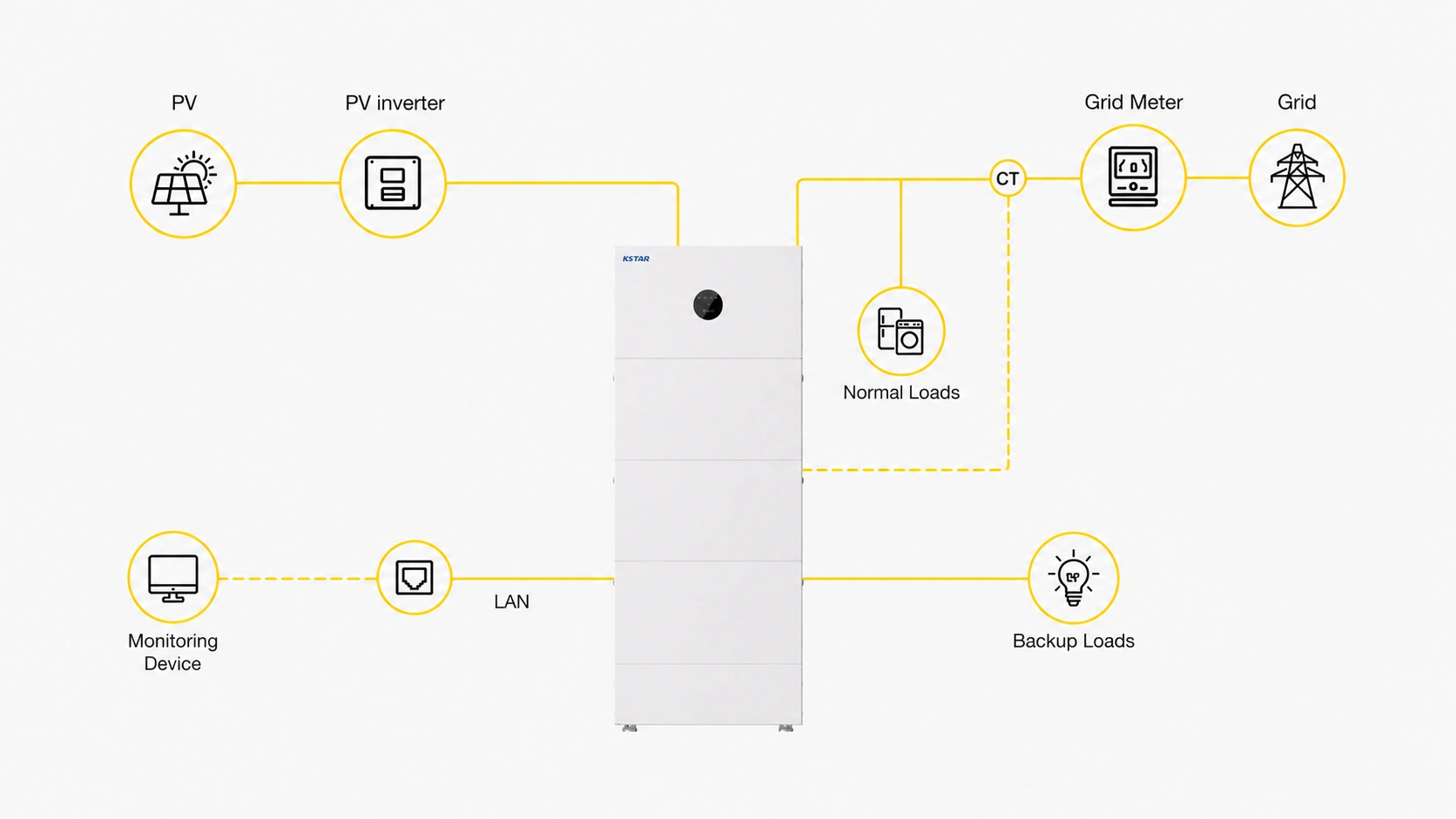
The right setup if you already have some PV installed and want to add both more panels and battery storage at the same time. Existing PV stays connected via its original PV inverter (AC-coupled); new PV panels feed straight into the BlueSpark’s DC inputs.
Topology 3 · Retrofit
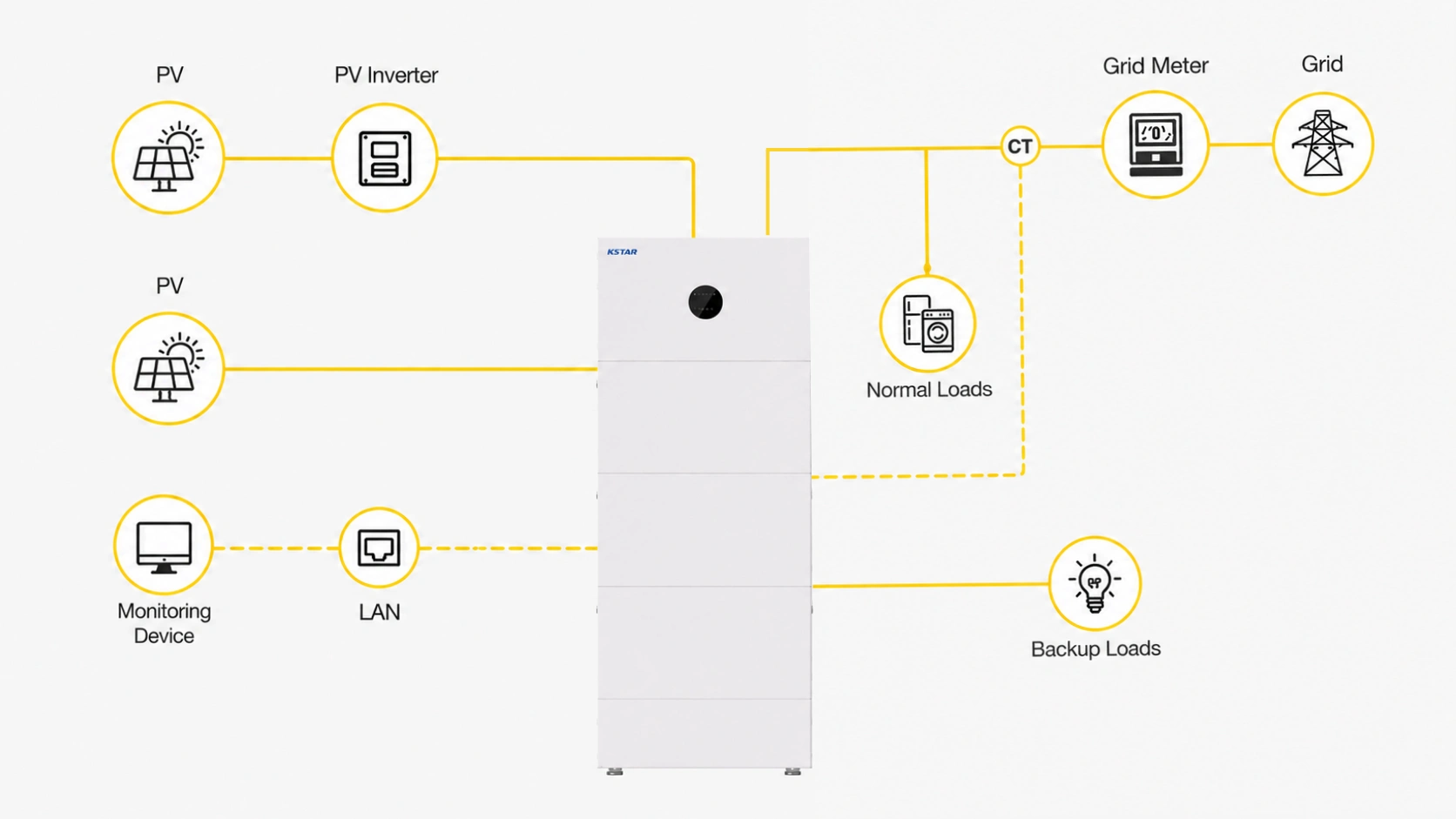
The right setup for retrofitting storage to an existing PV system without touching the PV array or its inverter. The BlueSpark connects to the AC bus only — it charges from surplus PV via the grid-side connection and discharges into household loads (and backup loads during outages).
The three diagrams show the official KSTAR-published wiring topologies for the BlueSpark Series. CGP Solar engineers confirm the right topology after a site survey — picking the wrong one for your situation costs you money and time, picking the right one means a clean install with no surprises on day one.
On a single-phase EAC connection? The same topologies apply, but you’ll need the single-phase BlueSpark variant instead. See our KSTAR BlueSpark single-phase residential ESS page for the 3.68–6 kW range built for single-phase homes.
Three inverter sizes × eight battery stack sizes = 24 configurations of the KSTAR BlueSpark three-phase residential ESS. Pick the inverter by your home’s peak load and PV array size; pick the battery by your typical evening kWh consumption and how many hours of backup autonomy you want during a grid outage.
|
Typical Home Profile
|
Recommended Inverter
|
Recommended Battery
|
Max PV
|
Evening kWh covered
|
|---|---|---|---|---|
|
Small family home · 1–2 bedroom
|
8 kW
|
2 modules · 10.24 kWh
|
16 kWp
|
~9.2 kWh usable
|
|
Standard family home
|
8 kW
|
3 modules · 15.36 kWh
|
16 kWp
|
~13.8 kWh usable
|
|
Large home + heat pump
|
10 kW
|
4 modules · 20.48 kWh
|
20 kWp
|
~18.4 kWh usable
|
|
Large home + heat pump + EV
|
10 kW
|
6 modules · 30.72 kWh
|
20 kWp
|
~27.6 kWh usable
|
|
Villa with high evening demand
|
12 kW
|
6 modules · 30.72 kWh
|
22 kWp
|
~27.6 kWh usable
|
|
Luxury villa · max self-sufficiency
|
12 kW
|
8 modules · 40.96 kWh
|
22 kWp
|
~36.8 kWh usable
|
Usable capacity is approximately 90% of total energy (4.6 kWh per module). Real evening coverage depends on appliance mix, season and self-consumption ratio. CGP Solar runs the calculation from your last 12 months of EAC bills.
Backup Power
The KSTAR BlueSpark three-phase residential ESS supports both on-grid and off-grid operation. When the grid drops, the inverter switches to its dedicated AC backup output and continues to power your home from the battery (or from PV + battery if the sun is up). Backup capacity matches the rated inverter power:
|
Inverter
|
Nominal Backup
|
Max Apparent
|
Backup Current
|
Single-phase max
|
|---|---|---|---|---|
|
E8KT-D22
|
8 kW
|
8 kVA
|
11.6 A
|
~2.7 kW per phase
|
|
E10KT-D22
|
10 kW
|
10 kVA
|
14.5 A
|
~3.3 kW per phase
|
|
E12KT-D22
|
12 kW
|
12 kVA
|
17.4 A
|
~4 kW per phase
|
With a fully charged battery and only essential loads on the backup circuit, the system can run a typical Cyprus home for many hours. Estimates below assume a 10 kW inverter + 4 battery modules (20.48 kWh total, ~18.4 kWh usable):
The same inverter with more modules in the KSTAR BlueSpark three-phase residential ESS extends runtime proportionally. With 8 modules at full 40.96 kWh (36.8 kWh usable), an average Cyprus three-phase home can run for most of a 24-hour period on backup — long enough for any realistic EAC outage in the country.
The KSTAR BlueSpark three-phase residential ESS supports parallel operation in both on-grid and off-grid modes. The transition from grid to backup is built into the inverter — no external transfer switch is required for standard residential backup circuits. Sensitive appliances (computers, fridges, modems) ride through the changeover without trouble.
Net Billing Cyprus
From 1 January 2026, Cyprus replaced the long-running net-metering scheme with net billing for all new residential PV installations. The change has direct, measurable consequences for any home installing solar from now on — and storage is no longer optional if you want the same economics you would have had under the old scheme.
The BlueSpark’s self-consumption mode is built exactly for this economics. The EMS prioritises charging the battery from solar surplus during the day, then discharges into household loads during the evening — exactly the period when the grid charges the highest retail rate. With up to 40.96 kWh of battery storage (8 modules × 5.12 kWh) on the three-phase BlueSpark, almost no PV generation needs to be exported at the wholesale rate; almost all of it offsets retail-rate import instead.
For a full breakdown of how net billing works in Cyprus and what it means for homeowners going forward, see our dedicated explainer: Net Billing Cyprus 2026 — what changed and what to do →
|
Battery Model
|
BP48100P1-G2
|
|---|---|
|
General Parameters
|
|
|
Battery Type
|
LFP (LiFePO4)
|
|
Cell Brand
|
EVE / CATL (optional)
|
|
Energy Capacity
|
5.12 kWh
|
|
Usable Capacity
|
4.6 kWh
|
|
Max.Depth of Discharge
|
100%
|
|
Nominal Voltage
|
51.2 V
|
|
Operating Voltage Range
|
44.8 ~ 57.6 V
|
|
Battery Pack Round-Trip Efficiecy
|
> 94%
|
|
Weight
|
51 kg
|
|
Dimensions (WxHxD)
|
725 x 418 x 165 mm
|
|
IP Protection
|
IP65
|
|
Warranty
|
5 Year Product Warranty
10 Year Performance Warranty |
|
Operation
|
|
|
Max. Continuous Charging Current
|
50 A (single battery pack)
|
|
Max. Continuous Charging Power
|
2825 W
|
|
Max. Continuous Disharging Current
|
80 A (single battery pack)
|
|
Max. Continuous Disharging Power
|
4096 W
|
|
Operating Temperature Range
|
-10 to 50℃ (Charging); -10 to 50℃ (Discharging)
|
|
Cooling Type
|
Natural Cooling
|
|
Humidity
|
0 ~ 90%
|
|
BMS
|
|
|
Modules Connection
|
Max. 8
|
|
Capacity
|
100 / 200 / 300 / 400 / 500 / 600 / 700 / 800 Ah
|
|
Communication
|
CAN
|
|
Monitoring Parameters
|
System voltage,current,battery voltage, Battery temperature,PCBA temperature measuremen
|
|
Certificate
|
|
|
Safety and Transportation
|
Pack:IEC/EN 62619;UN38.3; Cell:IEC/EN 62619;UN38.3;UL1973
|
|
Model Name
|
E8KT-D22
|
E10KT-D22
|
E12KT-D22
|
|
|---|---|---|---|---|
|
PV Input
|
||||
|
Recommended Max.PV Array Input Power @STC
|
16 kW
|
20 kW
|
22 kW
|
|
|
Max PV Voltage
|
1000 V
|
|||
|
Nominal Voltage
|
720 V
|
|||
|
MPPT Voltage Range
|
140 ~ 950 V
|
|||
|
MPPT Voltage Range with Full Load
|
290 ~ 800 V
|
320 ~ 800 V
|
350 ~ 800 V
|
|
|
Start Voltage
|
200 V
|
|||
|
Number of MPPT Tracker
|
2
|
|||
|
Number of MPPT Tracker
|
1
|
|||
|
Max. Input Current per MPPT
|
20 A
|
|||
|
Max. Short-Circuit Current per MPPT
|
25 A
|
|||
|
AC Output & Input (Grid)
|
||||
|
Max. AC Continuous Output Power
|
8000 W
|
10000 W
|
12000 W
|
|
|
Max. AC Apparent Output Power
|
8800 VA
|
11000 VA
|
13200 VA
|
|
|
Max. Continuous Input Power
|
16000 W
|
20000 W
|
22000 W
|
|
|
Nominal AC Voltage
|
400 Vac
|
|||
|
Norminal Frequency
|
50 Hz / 60 Hz (±5 Hz)
|
|||
|
Norminal Output Current
|
11.6 A (RMS)
|
14.5 A (RMS)
|
17.4 A (RMS)
|
|
|
Max. Output Current
|
26.1 A (RMS)
|
|||
|
Max. Input Current
|
38.8 A (RMS)
|
42 A (RMS)
|
||
|
Power Factor (cos ϕ)
|
-0.8 (Lagging) ~ 0.8 (Leading)
|
|||
|
THDi
|
< 3%
|
|||
|
AC Output (Backup)
|
||||
|
Nominal AC Output Power
|
8000 W
|
10000 W
|
12000 W
|
|
|
Max. AC Output Power
|
8000 VA
|
10000 VA
|
12000 VA
|
|
|
Nominal Output Current
|
11.6 A
|
14.5 A
|
17.4 A
|
|
|
Max. Output Current
|
26.1 A (RMS)
|
|||
|
Nominal Output Voltage
|
400 Vac
|
|||
|
Nominal Output Frequency
|
50 Hz / 60 Hz
|
|||
|
Output THDv (@Linear Load)
|
2% (Linear Load)
|
|||
|
Battery Input
|
||||
|
Battery Type
|
LFP (LiFePO4)
|
|||
|
Nominal Battery Voltage
|
51.2 V
|
|||
|
Charging Voltage Range
|
44 ~ 58 V
|
|||
|
Max. Charging / Discharging Current
|
160 / 200 A
|
200 / 240 A
|
||
|
Rated Charging / Discharging Power
|
8000 W
|
10000 W
|
10000W / 12000W
|
|
|
Battery Capacity
|
100 ~ 800 Ah
|
|||
|
Efficiency
|
||||
|
Max. PV Efficiency
|
97.2 %
|
|||
|
Euro. Efficiency
|
95.5 %
|
|||
|
Protection
|
||||
|
DC Switch
|
Yes
|
|||
|
Anti-Islanding Protection
|
Yes
|
|||
|
Residual Current Monitoring
|
Yes
|
|||
|
PV Reverse Polarity Protection
|
Yes
|
|||
|
AC Short Circuit Protection
|
Yes
|
|||
|
AC Overvoltage Protection
|
Yes
|
|||
|
DC / AC Surge Protection
|
DC Type II; AC Type II
|
|||
|
Remote Shutdown
|
Yes
|
|||
|
AFCI
|
Optional
|
|||
|
General Parameters
|
||||
|
Dimensions (W x H x D)
|
725 × 490 × 245 mm
|
|||
|
Weight
|
43 kg
|
|||
|
Topology
|
Transformerless
|
|||
|
IP Protection
|
IP66
|
|||
|
Operation Temperature Range
|
-25 ~ 60℃ (> 40℃ Derating)
|
|||
|
Operation Humidity Range
|
0 ~ 95% (No Condensing)
|
|||
|
Cooling Method
|
Natural Convection
|
|||
|
Max. Operation Altitude
|
4000 m
|
|||
|
Communication
|
RS485 / CAN2.0 / WIFI
|
|||
|
Display
|
LED / WIFI+APP / Web
|
|||
|
Certification & Standard
|
IEC/EN62109-1&2; IEC/EN 61000-6-1; IEC/EN 61000-6-2; EN 61000-6-3; IEC/EN 61000-6-4; IEC/EN 61000-3-11; EN 61000-3-12; IEC 60529; IEC 61727; IEC 62116; IEC 60068; IEC 61683; EN 50549-1; EN 50549-10; VDE-AR-N 4105; NC RfG:2018; C10/C11
|
|||
Certifications & Standards
The KSTAR BlueSpark three-phase residential ESS is supplied with the certifications below. The combination covers the European grid codes needed for EAC connection in Cyprus, plus all relevant battery safety standards.
IEC/EN 62109-1&2 — core safety standard for PV inverters and power-conditioning equipment. Covers electric shock, energy hazards, fire and mechanical safety.
IEC/EN 61000-6 series — EMC standards. Immunity (-6-1/2) means the system keeps working despite interference; emissions (-6-3/4) means the system doesn’t interfere with other equipment.
IEC 61727 & IEC 62116 — grid-interconnection standards. 61727 covers PV characteristics for utility interface; 62116 is the anti-islanding protection test method.
EN 50549-1 / EN 50549-10 — European generic grid-connection requirements for distributed generation. Required for EAC connection in Cyprus and most EU markets.
VDE-AR-N 4105 — German national grid code for low-voltage generation up to 50 kVA. One of the strictest residential inverter standards globally.
C10/C11 (Synergrid) — Belgian grid code for low-voltage installations. For the 10 kW model, max apparent output is capped at 10 kVA / 14.5 A under C10/11.
IEC/EN 62619 — core safety standard for industrial lithium-ion batteries in stationary applications. Tests cells and modules for thermal propagation, overcharge and abuse.
UN 38.3 & UL 1973 — UN 38.3 is the global lithium battery transport standard; UL 1973 is the North American standard for stationary battery cells used in ESS.
Inverter Protection
The KSTAR BlueSpark three-phase residential ESS hybrid inverter ships with the following protections integrated as standard. No external protection devices needed for a standard residential installation:
The KSTAR BlueSpark three-phase residential ESS hybrid inverter is rated IP66 with natural convection cooling, weighs 43 kg, measures 725 × 490 × 245 mm, and is transformerless. Operating temperature range is −25 °C to +60 °C with derating above 40 °C.
Installation Process
Residential ESS installation is much faster than commercial — typically completed in 1 day on site once the EAC paperwork is in place. Typical project timeline:
Warranty
Every KSTAR BlueSpark three-phase residential ESS is covered by KSTAR’s official two-part manufacturer warranty:
KSTAR BluePulse C&I ESS · CGP Solar Cyprus
Twenty-four factory-built configurations cover everything from a standard family home to a luxury villa with heat pump, EV charger and high evening demand. Three inverter sizes (8, 10, 12 kW) × eight battery stacks (5.12 to 40.96 kWh). All using CATL or EVE LFP cells. All backed by KSTAR’s 5-year product / 10-year performance warranty.
CGP Solar is the authorised KSTAR distributor in Cyprus. We handle the full residential project end-to-end — site visit, system sizing, EAC paperwork, delivery, installation in one day, commissioning over Bluetooth, cloud monitoring activation, and warranty service.
Contact us today to schedule your personalised consultation and discover how the KSTAR BlueSpark three-phase residential ESS in Cyprus can help you start saving on electricity bills.
FAQ’s
This product page covers the three-phase BlueSpark range (8/10/12 kW), which is the right choice for the majority of Cyprus family homes — they’re typically wired with three-phase EAC connections. For homes on single-phase connections, KSTAR makes a dedicated single-phase BlueSpark Series (3.68–6 kW) — see our KSTAR BlueSpark single-phase residential ESS page. The 8–12 kW three-phase range gives much higher capacity headroom for heat pumps and EV chargers, and supports 100% unbalanced output. CGP Solar confirms the EAC connection type at site survey before quoting.
Yes. KSTAR officially supplies the BP48100P1-G2 battery packs with cells from either CATL or EVE — both Tier-1 LFP cell manufacturers. CATL is the world’s largest battery cell producer; EVE is one of the top global LFP suppliers. Which brand is in your specific delivery depends on factory stock at the time — CGP Solar can confirm at order time.
With the 10 kW or 12 kW inverter and 4+ battery modules, yes — the KSTAR BlueSpark three-phase residential ESS can typically power a whole standard Cyprus family home (lights, fridges, AC, kitchen, water pumps, security) for 6–10 hours of evening operation. With 8 modules at full 40.96 kWh capacity, runtime stretches to most of a 24-hour period. Whether you can also keep heat pump and EV charging running depends on the inverter size and how many appliances run simultaneously.
Yes. The KSTAR BlueSpark three-phase residential ESS is modular — you can start with 1 or 2 modules and add more later (up to a maximum of 8 modules per system). The BMS and EMS automatically detect new modules. Adding modules is significantly cheaper than oversizing on day one, so a common strategy is starting at the size that covers current needs, then expanding when an EV or heat pump is added.
Yes. The KSTAR BlueSpark three-phase residential ESS hybrid inverter is rated −25 °C to +60 °C with derating above 40 °C. Battery modules with the heating-foil option (BP48100PF1-G2) operate from −10 °C to +50 °C in both charging and discharging. Cyprus ambient temperatures sit comfortably inside the design envelope. The inverter’s IP66 rating means it can be installed in unshaded outdoor positions without enclosure modifications.
KSTAR’s official warranty on every BlueSpark three-phase residential ESS is two-part: a 5-year product warranty covering the full system (hybrid inverter, battery packs, BMS, cooling, safety) and a 10-year performance warranty covering the LFP battery’s usable capacity. CGP Solar handles all claims directly as KSTAR’s authorised distributor in Cyprus.
Yes. For commercial and industrial sites above 12 kW, KSTAR makes the BluePulse Series. The 30–50 kW range fits most mid-sized factories, hotels and farms; the 80–125 kW range covers larger industrial sites. See our KSTAR BluePulse 30–50 kW commercial ESS page or KSTAR BluePulse 80–125 kW C&I ESS page.
KSTAR’s official warranty is two-part: a 5-year product warranty covering the full KSTAR BluePulse 30–50 kW commercial ESS (battery cabinet, hybrid inverter, BMS, EMS, cooling, safety hardware), plus a 10-year performance/cycle warranty covering the CATL LFP battery’s usable capacity. CGP Solar, as authorised KSTAR distributor in Cyprus, handles all warranty claims directly.
No. The KSTAR BluePulse 30–50 kW commercial ESS has direct backup output built into the hybrid inverter with approximately 10 ms on/off-grid switching. No external transfer switch or separate UPS is required — sensitive loads like servers and PLCs ride through the 10 ms transfer without rebooting.
Yes. The 80–125 kW BluePulse range (KAC80/100/110/125 DP2) is the next step up, with the same battery cabinet options (197 / 215 kWh). See our KSTAR BluePulse 80–125 kW C&I ESS page.
| Power output | 8kW, 10kW, 12kW |
|---|


Visit our show room:
Working hours:
Get in touch:
Find us on:

