
Available now
Every panel here is N-type HJT, bifacial and double glass, from 400W to 700W. Prices include VAT and delivery anywhere in Cyprus, and stock orders usually leave our Paphos warehouse within 2-4 working days.


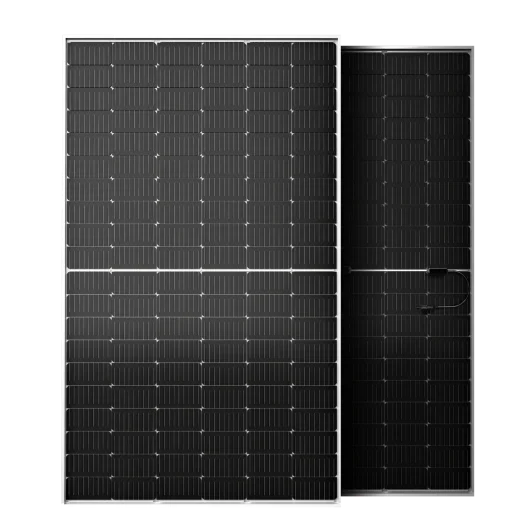


Why we sell HJT
Worth knowing before you start comparing wattages. Every panel on the market is rated at 25 °C, measured under lab light. Put that same panel on a roof in Nicosia in July and the module itself sits at 60 to 70 °C, and it makes less than the sticker says. All of them do this. The question is how much.
That’s the temperature coefficient, and it’s printed on every datasheet if you go looking for it. Ours is −0.24 %/°C, so at 65 °C an Akcome module is down about 9.6% from its rating. A cheap PERC panel at −0.35 %/°C is down 14%. Sounds small, until you think about when it happens: two in the afternoon in August, with the air conditioning flat out.
So we don’t sell PERC. We’d make better margin on it and it would undercut everything on this page, but we’d rather not be having a conversation two summers from now about why the system disappoints in the heat.
Output lost to heat at 65 °C module temperature
Measured against the 25 °C laboratory rating
Build quality · what lasts
Below are the specifications we assess before adding a panel to our own range. They work just as well on any quote you are comparing.
Before you order
Panel counts and roof areas for four common system sizes. A firm figure comes after we have seen the property.
|
System size
|
400W panels
|
450W panels
|
480W panels
|
690W panels
|
Estimated yearly output
|
Typical fit
|
|---|---|---|---|---|---|---|
|
5 kW
|
13
|
12
|
11
|
8
|
7,500 – 9,100 kWh
|
Family home with air conditioning
|
|
6 kW
|
15
|
14
|
13
|
9
|
8,700 – 10,300 kWh
|
Four-bedroom home, heavy summer use
|
|
7 kW
|
18
|
16
|
15
|
11
|
10,400 – 12,500 kWh
|
Villa with air conditioning throughout
|
|
8 kW
|
20
|
18
|
17
|
12
|
11,600 – 13,700 kWh
|
Villa with a pool pump
|
|
10 kW
|
25
|
23
|
21
|
15
|
14,500 – 17,100 kWh
|
Large villa, small business unit
|
|
12 kW
|
30
|
27
|
25
|
18
|
17,400 – 20,500 kWh
|
Large villa with pool and EV, small commercial
|
Panel counts are rounded up so each system reaches at least the size shown, which puts real capacity slightly above it — a 5 kW system lands between 5.2 and 5.5 kWp depending on the panel. The range runs from roughly 1,450 kWh per kWp on a dusty inland roof to about 1,650 on a clean one near the coast. Panels only, inverter, frames, cabling, protection and labour are separate.
Every price we give follows a site visit. Shading through the day, roof condition and the cable run cannot be judged from a photograph, so we come and look. You get back a panel count, a layout and an itemised price, free.
Worth knowing
Photovoltaic panels in Cyprus lose output for three reasons that have nothing to do with the panel you bought. A good module badly placed will cost you more than a cheap one well placed, none of this appears on a datasheet, and all of it can be designed around.
Affects the whole string
Panels wired in series perform to the weakest one in the string, so a single shaded panel drags down every panel connected to it. A chimney, a solar water heater, a satellite dish or a neighbour’s tree in low winter sun will all do it, and often only for part of the day.
The answer is in the design rather than the panel. Split the array into separate strings so the shaded section is isolated, or use microinverters so every panel works on its own and a shaded one costs you only that panel.
Builds up unnoticed
Cyprus gets Saharan dust, and a dry summer can run for weeks with nothing to wash it off. Dust on the glass blocks light before it ever reaches a cell, and because it accumulates gradually almost nobody notices the drop happening.
Shallow and flat arrays hold more of it than steep ones, since rain runs off a steeply tilted panel and sits on a shallow one. Panel cleaning is the cheapest output you will ever buy back.
Fixed at installation
South-facing at a moderate tilt produces the most electricity across a full year. An east-west split produces less in total, but spreads what it does produce across the morning and the evening rather than concentrating it around midday.
Which suits you depends on when the building actually uses power. A house that stands empty from nine to five wants a different layout from one with someone home and the air conditioning running all day, and a business is different again.
Every district · free delivery
We are based in Paphos and deliver across the island free of charge. We also ship to Europe on request.
Our home district and our showroom. Villas in Chloraka, Kissonerga, Peyia and Coral Bay, plots out at Polis and Latchi. Salt air decides the specification here, which is why we don't sell backsheet panels.
Rooftops in Germasogeia, Agios Tychonas, Amathus and Pissouri, and ground mounts up in the Krassochoria wine villages — Omodos, Vasa, Kilani. The district covers a lot of ground, from seafront apartments to plots up in the hills.
The hottest summers on the island, so the temperature coefficient does more work here than anywhere else. Homes in Strovolos, Latsia, Aglantzia and Lakatamia, warehouse roofs across the Mesaoria plain.
Flat concrete roofs in Oroklini, Livadia, Pyla and Perivolia take a tilted frame well, and that is one of the few places a bifacial rear side earns something. Greenhouses around Kiti and Aradippou too.
Hotels and apartments in Ayia Napa, Protaras, Paralimni and Kapparis, where consumption peaks in the same months production does. Farms across the Kokkinochoria — Sotira, Liopetri, Frenaros, Xylophagou.
Stone houses and agritourism properties in Pano Platres, Arsos, Agros and Vavatsinia. Sites this high need more thought than a coastal roof, from access for the delivery to how the system performs through the winter months.
Buying from CGP Solar
Three ways to buy, depending on how much of the job you want to handle yourself. Whichever you choose, delivery is free anywhere in Cyprus and a warranty claim comes back to our Paphos office
Buy the modules and fit them with your own electrician. Free delivery to any address on the island, no minimum order, and no pressure to tae anything else.

Bifacial module ensures 30-year outdoor operation, longer than the conventional type of normally 25 years.
An advanced solution that enables more energy generation light capturing and elegant appearance.

The back of the dual-glass module adopts high transparent glass, which can adapt to all kinds of harsh environment.

The lower temperature coefficient and better low irradiance performance of HJT technology can effectively reduce LCOE.

The dual-glass module has a bifaciality up to 90% and a power generation gain of 7%-30% on the back side.

Temperature coefficient as low as −0.24 %/°C
About photovoltaic panels in Cyprus
Everything below is about choosing and buying the panels themselves. It applies to photovoltaic panels in Cyprus generally, not only to what we stock, and it is written to be useful against anyone’s quote.
Three cell technologies are sold on the island. The practical difference between them is how much output each gives up as it heats, which is why the comparison below matters more here than it would in northern Europe.
|
Technology
|
Silicon
|
Temp. coefficient
|
In practice
|
|---|---|---|---|
|
PERC
|
p-type
|
≈ −0.35 %/°C
|
Cheapest. Loses a small amount permanently in its first hours of sun
|
|
TOPCon
|
N-type
|
≈ −0.29 %/°C
|
No light-induced degradation, better in heat than PERC
|
|
HJT N-type
|
N-type
|
−0.24 to −0.255 %/°C
|
Best heat behaviour and best low-light response
|
All three are also sold as monofacial or bifacial. A bifacial panel has glass on both faces and can generate from light reflected off the surface underneath, though how much depends on the mounting rather than the panel.
There is no single best panel, and any supplier who names one before seeing your roof is selling rather than advising. There is the panel that suits your situation, and it usually comes down to which of three constraints you are working against.
After that, look at the two warranties rather than the brand. A product warranty of 12 to 15 years and a power warranty of 25 to 30 years is the current standard, and a panel that falls short of it is telling you something.
Our panels start at €215. Bigger panels cost more.
But panels are only part of the price. A working system also needs:
This is why quotes for solar panels in Cyprus can look completely different. One may cover the whole job. The other may be panels only.
Always ask for a full breakdown before you compare.
Efficiency is how much of the light hitting a panel turns into electricity. Panels today are between 20% and 23%.
A higher number does not mean more electricity overall. It means more electricity from the same space. On a 30 m² roof, the difference between a 21.5% panel and a 23% panel is about 600 watts — roughly one extra panel.
So efficiency matters when the roof is small. If you have room to spare, fitting one more panel does the same job for less money.
Most homes here end up with 5 to 8 kW. That is roughly 11 to 17 panels.
The right size comes from your electricity bill, not from your roof. A system built to fill the roof will cost more and earn back less.
The usual problem on a Cyprus roof is not space, it is clutter. Solar water heaters, vents, chimneys and satellite dishes all take up room and cast shade. Sometimes a shorter panel fits where a bigger one will not.
Warehouse roofs, farm buildings, hotels and ground mounts suit high-wattage panels. Fewer panels for the same power means fewer clamps, fewer connections and less time on the roof.
Fire rating is worth checking on commercial work. Some specifications and insurers ask for Class A in writing. A homeowner never will.
Commercial buildings are quoted like any other job, after a site visit. Wholesale pricing is separate, and only for installers and resellers buying at volume.
Four questions worth asking any supplier, including us:
We sell Akcome and Mingyang. Both make N-type HJT panels with glass on both sides. We do not stock anything else, and there is a reason for that.
Akcome build heterojunction panels with a double-glass laminate and no plastic backsheet. Theirs carry a Class A fire rating and a temperature coefficient of −0.24 %/°C — the lowest in our range, which is what earns them their price on a hot roof. Product warranty is 12 to 15 years depending on the model, with 30 years on the power warranty.
Mingyang Smart Energy is one of the larger renewable energy manufacturers in the world. Their HJT panels are the best value we carry: the 450W runs at 23% efficiency, the highest of anything we stock, which makes it the one to fit when roof space is tight. Fifteen years product warranty, 30 years on power.
Both are N-type HJT, so they lose less output in a Cyprus summer than the PERC panels still sold here
Both have glass on both faces instead of a plastic backsheet, which matters near the coast where backsheets age badly
Both carry a 30-year power warranty
We are an authorised distributor for both, so a warranty claim is dealt with here in Paphos
We supply and install across the island from our base in Paphos, and delivery is free to every district with no minimum order. Coastal sites at Chloraka, Peyia, Germasogeia and Protaras are decided by salt exposure, which is where double-glass construction earns its cost. Inland, Nicosia and the Mesaoria give the hottest summers on the island and put the most weight on temperature coefficient. Larnaca’s flat concrete roofs suit tilted frames, and the Troodos villages need more planning for access and winter conditions.
Equipment ships to Europe as well, quoted per order by weight and destination.
Contact us via phone, email, or website form today to get your free solar consultation.
FAQ’s
Eleven 480W panels. That gives you 5.28 kW.
In Cyprus a system that size makes somewhere between 7,500 and 9,100 kWh a year. Where you are on the island makes a difference, and so does how often the panels get cleaned.
Whether 5 kW is right for you is a different question. That comes from your electricity bill, not from the size of your roof.
Because of the heat.
Every panel loses output as it warms up. How much depends on the technology. PERC, the cheapest type, loses about 0.35% for every degree above 25 °C. TOPCon loses about 0.29%. HJT, which is what we sell, loses between 0.24% and 0.255%.
In northern Europe that hardly matters. On a Cyprus roof in August, with the panel sitting at 65 °C, it is the difference between losing a tenth of your power and losing a seventh.
Yes, photovoltaic panels generate electricity even on cloudy days, though efficiency may be reduced. Thanks to Cyprus’ high solar irradiation, solar systems still produce a significant amount of energy year-round.
A standard panel has a plastic backsheet, and that backsheet is the part that ages worst — it yellows, chalks and can delaminate under years of UV and salt air. A double-glass panel has glass on both faces instead, which is why every module we sell is built that way.
It also lets light reach the cells from behind, which is what makes a panel bifacial. How much the rear side adds depends on what is underneath it.
Yes, but not within one string.
Panels wired in series should be the same model and the same wattage. A string works to its weakest panel, so one odd module drags the rest down with it.
Two different models are fine on separate MPPT inputs — our Sinexcel Isuna inverters have them. Microinverters work too, because each panel runs on its own.
If you are adding to a system that is already on the roof, tell us. Matching what is up there usually matters more than buying the newest model.
It goes to the grid and you get paid for it, but not at the price you pay to buy electricity back.
Cyprus moved to net billing on 1 January 2026. What you export earns a wholesale rate. What you buy back in the evening is charged at the retail rate. The two are worked out separately on your bill.
So it pays to use your own electricity while it is being made — the pool pump, the water heater, the washing machine, all during daylight. A battery does the same job by holding the surplus until the evening.
Not at the moment. The Photovoltaics for All scheme and the RES Fund grants for home solar closed to new applications on 31 December 2025, and nothing has opened since.
A battery subsidy tied to the new net billing rules has been announced in principle, but it has not launched.
These schemes come and go, so ask us when you get in touch — we follow them, and we handle the EAC application either way. Our net billing page is where we keep the current position.
Usually yes. It is far easier when it was planned for at the start.
Three things decide how simple it will be: whether the inverter has capacity left or a spare MPPT input, whether there is roof space left with a decent orientation, and whether the EAC approves the change in capacity.
If you think you might expand later — a pool, a heat pump, an electric car — say so at the design stage. Sizing the inverter with room to grow costs very little now. Replacing it in three years costs a great deal more.
Visit our show room:
Working hours:
Get in touch:
Find us on:

