
Cyprus · Self-Priming · DC & AC/DC Hybrid
Solar pumps for agriculture in Cyprus
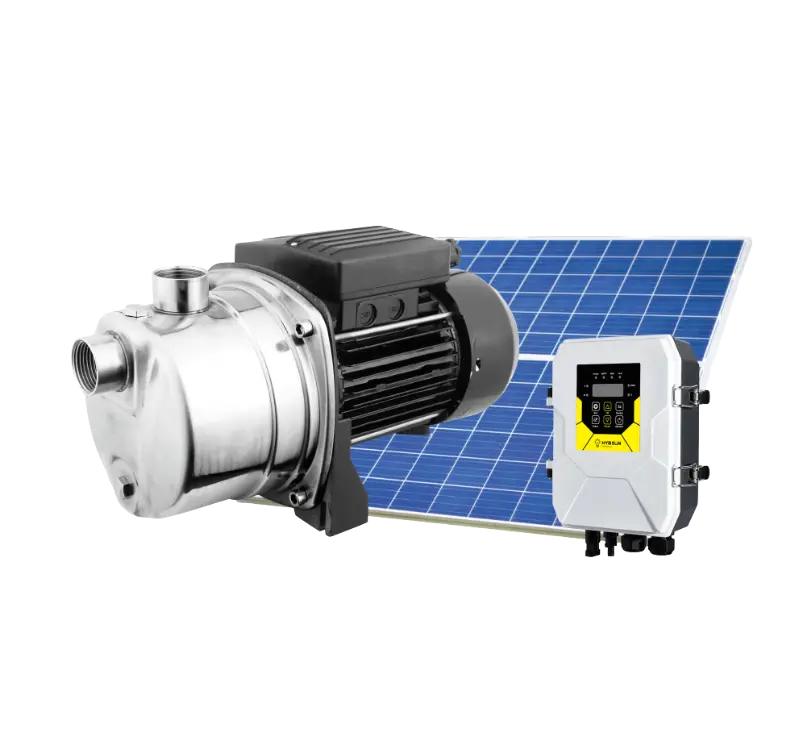
Above-ground pumps that prime themselves and pull water from shallow wells, tanks, ponds or rivers. Hybsun SJET series — for orchards, vineyards, drip lines and small-to-medium plots.
✦ Hybsun authorised distributor
✦ DC & AC/DC hybrid
✦ Local warranty
Available now
Our solar self-priming pumps for agriculture
Hybsun surface pump models in DC-only and AC/DC hybrid versions. DC for pumping direct from solar panels, hybrid for round-the-clock supply with automatic grid backup.


DC-only or AC/DC hybrid?
Two ways to power a solar agricultural pump
Both options are available in the Hybsun agricultural range. The right choice depends on whether your farm needs water only during daylight, or around the clock.
Solar-only DC Solar Agricultural Pump
Panels → MPPT controller → pump
Runs directly off solar panels with no inverter or battery
Fewer components, longer service life, less to go wrong
Lowest upfront cost and lowest ongoing maintenance
Fills storage tanks during daylight — gravity delivers water 24/7
Zero electricity cost during operation
Only pumps while the sun is shining
Best for:
Olive groves and vineyards with drip irrigation, storage-tank systems, off-grid farms in Troodos and remote Paphos villages, any farm where irrigation can happen during daylight
AC/DC Hybrid Solar Agricultural Pump
Panels + grid → smart pump (no inverter needed)
Accepts both solar DC (90–430V) and AC mains input directly
Auto-switches to grid or generator when the sun's not out
Runs day, night, cloudy weather — any hour, any conditions
Still saves on EAC bills during daylight hours
Same self-priming action and construction as the DC version
Higher upfront cost, slightly more complex install
Best for:
Greenhouses with scheduled irrigation, livestock water supply, farms with fixed schedules that must run day and night, or any operation that can’t stop at sundown.
How it works
Three components. That's it.
A solar pump for agriculture is simpler than a full home solar setup. No inverter, battery or monthly bill — just three parts that work together whenever the sun is out.
Solar Panels
MPPT Controller
Water Pump
Planning your system
Match your pump to what you grow
Sizing a solar pump for agriculture starts with your daily water requirement — which starts with knowing what you’re growing. For most Cyprus farms, water needs fall into predictable ranges based on crop type, plot area and irrigation method.
For drip-irrigated orchards and vineyards, water consumption is far lower than flood or sprinkler irrigation on the same area — often 30-50% less, which is a big factor when sizing pump wattage.
A 750 W self-priming solar agricultural pump delivers roughly 10,000–14,000 litres over a typical 6-hour solar day in Cyprus summer (varies by pump head and pipe network) — enough for 0.5–1.5 hectares of drip-irrigated olives or vines, or a smaller area of vegetables. For larger farms or higher-demand crops, we spec 4″ or 6″ borehole pumps.
Send us your crop type, plot area and irrigation method (drip, sprinkler or flood), plus your water source details. We’ll spec the pump, panel array and storage tank for your setup — typically within a couple of working days.
Peak summer water needs · drip irrigation
Olive trees Traditional grove
20–50 L per tree · per day
Vineyard Wine or table grape
3–8 L per vine · per day
Citrus Orange, lemon
25–50 L per tree · per day
Vegetables Open field, drip
25–45 L per m² · per week
Greenhouse tomatoes Hydroponic
1–3 L per plant · per day
Greenhouse tomatoes Hydroponic
2–5 L per plant · per day
Livestock Cattle, sheep, goats
4–70 L per head · per day
Cyprus-wide install
Serving every farming region solar surface pumps in Cyprus
Free delivery Cyprus-wide on all products. Installation service available across every district.
-
Paphos district
Olive groves in Pissouri, Kissonerga, Polis; small mixed farms across the Paphos hills, reactivated old wells for orchards.
-
Limassol district
Vineyards in the Krassochoria wine villages — Omodos, Vasa, Vouni, Kilani. Plus citrus orchards and mixed farms.
-
Nicosia district
Largest farming region — grain, potatoes, olives, vegetables across Astromeritis, Peristerona, Kokkinotrimithia, Lythrodontas.
-
Larnaca district
Greenhouses and market-garden operations around Kiti, Meneou, Athienou, Aradippou. Grain and potato fields inland.
-
Famagusta district
Kokkinochoria potato-growing region — Sotira, Liopetri, Frenaros, Deryneia, Avgorou, Xylophagou. Almost entirely borehole-fed.
-
Troodos & off-grid
Mountain plots and isolated fields where EAC extension costs more than the pump itself — solar is the only sensible option.
Solar pumps for agriculture in Cyprus Guide
Solar pumps for agriculture in Cyprus — everything you need to know
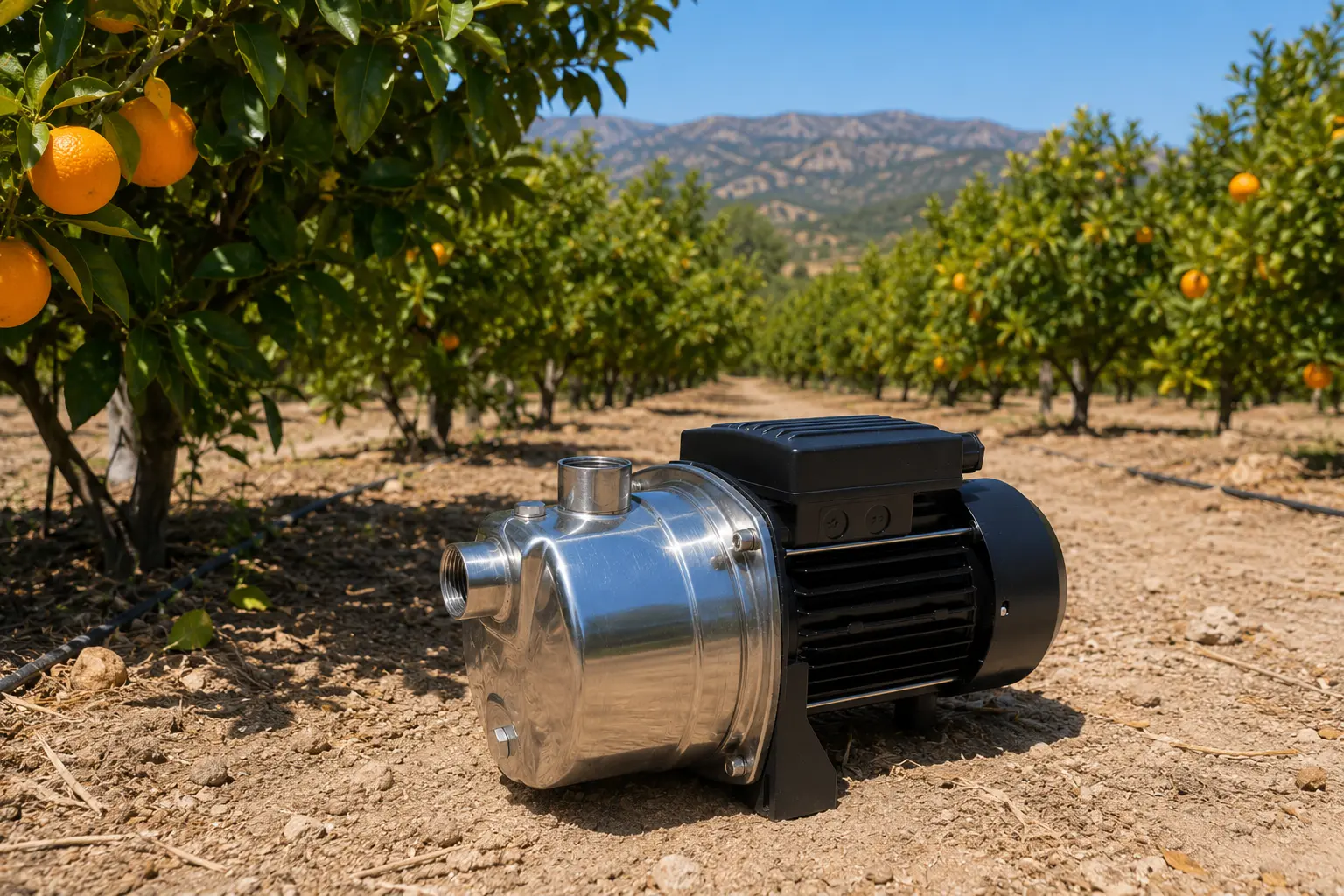
Solar pumps for agriculture in Cyprus replace one of the biggest recurring costs on any working farm — the electricity or diesel to run irrigation. Instead of paying for pumping every month, a solar agricultural pump takes energy directly from photovoltaic panels above ground and delivers water whenever the sun is out. CGP Solar is the authorised Cyprus distributor for Hybsun agricultural pumps, covering both DC-only and AC/DC hybrid configurations for every farming operation across the island.
Why Cyprus farmers switch to solar pumps for agriculture
The economics have shifted meaningfully over the past few years. EAC electricity prices have risen sharply, diesel remains volatile, and panel prices have fallen to historical lows. Meanwhile, solar output peaks between late morning and early afternoon — which is exactly the optimal daytime irrigation window, before peak heat drives water evaporation.
- Zero fuel cost during operation — no diesel, no EAC bill during daylight
- No grid connection required for DC-only systems — perfect for remote plots
- Long service life — brushless DC motors typically run 10-15 years with minimal servicing
- Solar timing matches irrigation timing — water delivered at peak sun reaches the roots, not the atmosphere
- Payback usually within 2-4 years for typical farm applications in Cyprus
Solar pumps for agriculture — DC-only vs AC/DC hybrid
Both configurations are available across the Hybsun agricultural pump range. Choose based on when your farm needs water:
DC-only solar pumps for agriculture run directly off solar panels through an MPPT controller. No inverter, no battery, no grid connection required. This is the simplest and most cost-effective option. Water is pumped during daylight and stored in a tank; gravity or a small pressure pump delivers water to your crops around the clock. The DC-only setup is ideal for olive groves, vineyards, drip-irrigated orchards, and any farm where a storage tank is practical.
AC/DC hybrid solar pumps for agriculture accept both solar DC input and AC mains input in the same unit — no separate inverter needed. During daylight the pump runs on solar; when the sun’s not out, it automatically switches to grid or generator power. This configuration is essential for greenhouses on fixed timers, livestock water supply that can’t stop, and any operation that needs guaranteed 24/7 supply regardless of weather.
Self-priming vs standard surface pumps — which type do you need?
Both self-priming and standard surface pumps sit above ground, but they solve different problems. Picking the right type depends on your water source, not just how big your farm is.
Self-priming solar pumps for agriculture — like the ones on this page — prime themselves automatically on start-up. The pump expels air from the suction line without you filling it manually, then pulls water up from below the pump inlet (up to about 8 metres of suction lift). If the water level drops and the suction line loses water, the pump re-primes on its own once the source refills. This is what makes them practical for wells with seasonal water level changes, shallow ponds that draw down during dry months, river-fed systems, and any Cyprus farm where the pump sits above a variable water source.
Standard solar surface pumpsare also above-ground centrifugal pumps, but they need to be primed manually before the first use — you fill the pump body with water to start it. Once running, they typically deliver higher flow rates than self-priming pumps at the same wattage. But they lose their prime if the suction line ever runs dry, and won’t restart until manually re-primed. That’s why they work best when the water source stays consistently at or above the pump inlet — feeding from an elevated storage tank into an irrigation network, boosting pressure between reservoirs, or pumping between two connected tanks.
For most Cyprus farming setups — wells, ponds, rivers, or any source with a variable water level — self-priming is the safer, more reliable choice. If you have an elevated storage tank feeding your irrigation network and the pump is downstream of the tank at a lower level, a standard solar surface pump may fit better.
Hybsun self-priming pump build quality
Every JET and JET-H self-priming solar pump for agriculture in the Hybsun range is built with the same core components:
- Iron pump body — durable construction rated for continuous farm use
- Brushless permanent-magnet DC motor — over 90% efficient, quieter than AC induction, no carbon brushes to wear
- NSK bearing with alloy mechanical seal — long service life under continuous operation
- MPPT controller with dry-run protection, soft-start, adjustable speed, phase-loss protection, overload and over-current protection
- IP65 controller protection — dust-tight and rated against water jets, suitable for outdoor farm installations
- CE and ISO9001 certified with a 24-month manufacturer warranty processed locally through us in Paphos
Larger farms — when to consider solar well pumps instead
Self-priming pumps have a physical suction limit of about 8 metres — that’s atmospheric pressure at work, not a Hybsun limitation. If your borehole or well is deeper than 8m below the pump inlet, or your farm needs the flow rates of a commercial-scale system, solar well pumps (submersibles) are the right choice. Our Hybsun well pump range covers 3″, 4″ and 6″ borehole diameters up to 210m deep and 5,500 W of pump power — used across Cyprus farms in the Kokkinochoria, Mesaoria plain, and deep-borehole regions everywhere.
What you can pump with solar agricultural pumps
- Drip irrigation networks — olive groves, vineyards, citrus orchards, vegetable rows
- Micro-sprinkler systems for greenhouses and small-plot vegetable farming
- Storage tank filling — pumping from a source to an elevated tank for gravity distribution
- Livestock water supply — troughs, drinking stations, cooling systems
- Greenhouse feed — hydroponic systems, misting, climate control water
- Rainwater harvesting — pumping stored winter water back into the farm distribution network in summer
For pumping from deep boreholes or high-flow commercial farms, see our solar well pumps — submersible pumps designed for depths that surface pumps can’t reach.
Solar pumps for agriculture across every Cyprus district
We deliver and install solar pumps for agriculture across Cyprus, from coastal farms to remote mountain plots:
- Paphos district — olive groves in Pissouri, Kissonerga, Polis; mixed farms across the Paphos hills
- Limassol district — vineyards in the Krassochoria wine villages (Omodos, Vasa, Vouni, Kilani); citrus orchards
- Nicosia district — grain, potato, olive and vegetable farms across the Mesaoria plain (Astromeritis, Peristerona, Kokkinotrimithia, Lythrodontas)
- Larnaca district — greenhouses and market-garden operations around Kiti, Meneou, Athienou, Aradippou
- Famagusta district — potato and vegetable farms in the Kokkinochoria (Sotira, Liopetri, Frenaros, Deryneia, Avgorou, Xylophagou)
- Troodos and off-grid — mountain farms, agritourism sites, and any remote plot where extending EAC would cost more than the pump itself
What to send us for a solar pump quote
To spec the right solar pump for your farm, we need four practical details. Send them on the contact form and we come back with a specific pump model, panel array size, and total installed price — usually within a couple of working days.
- Water source and depth — well, borehole, tank, pond, or river; how far below the pump inlet does the water sit
- Daily water requirement — litres per day, or plot area + crop type if you want us to calculate
- Storage — tank size and elevation, if any
- Irrigation timing — daytime only, or fixed schedule requiring 24/7 supply
Contact us via phone, email, or website form today to get your solar pump free consultation.
FAQ’s
Most asked questions
about solar pumps for agriculture in Cyprus
Solar panels feed DC power through an MPPT controller to the pump motor. The pump sits above ground and, on first start-up, primes itself by expelling air from the suction line — pulling water up from a source below its inlet. Once primed, it delivers water continuously as long as the sun’s providing enough power. If it loses prime (e.g. air enters the suction line), it re-primes automatically. If the source runs dry, the controller stops the pump and restarts it 30 minutes later.
A self-priming pump can pull water from below its own inlet level without needing to be manually filled with water first. That matters when your water source (open tank, pond, river, shallow well) sits below the pump. Standard centrifugal pumps have to be primed manually every time they lose water in the suction line — a self-priming pump handles it automatically. Hybsun’s SJET series pumps prime themselves from up to about 8 metres below the pump inlet.
A 750 W self-priming pump for a small orchard runs on 3–4 panels (about 1,200–1,600 W of PV). A 550 W pump needs 2–3 panels (about 800–1,200 W). A 370 W entry-level pump runs on 2 panels. Rule from Hybsun spec sheets: PV wattage should be at least 1.3× the pump’s rated power.
DC-only for daytime irrigation with a storage tank — cheapest, simplest, longest life. AC/DC hybrid for scheduled irrigation that must run day and night (greenhouses on timers, livestock water supply, contract farming with rigid delivery schedules). Hybrid accepts both solar DC (90–430 V) and AC mains (90–300 V) in the same unit.
Every Hybsun controller has dry-run protection built in. If the water level drops below the pump intake, the controller stops the pump automatically and restarts it once water returns. No manual intervention, no motor damage.
Quality DC submersible and jet pumps typically run 15–20 years with basic maintenance. Brushless permanent-magnet motors mean no carbon brushes to wear, no scheduled servicing. The MPPT controller is the shortest-lived component at around 10 years and is inexpensive to replace.
There are periodic Rural Development Programme grants for on-farm renewable-energy equipment through the Cyprus Ministry of Agriculture, and EU CAP funding covers on-farm irrigation modernisation in some cases. Programmes change year to year — call us before ordering and we’ll check current schemes for your farm.
No — you can’t retrofit a standard AC pump to run on solar. Solar pumps use brushless DC motors and dedicated MPPT controllers designed to match variable solar input, conventional AC induction pumps can’t handle this. You replace the pump itself that connects directly to the panels. Existing plumbing, drip lines and storage tanks stay as they are — only the pump changes. Most installs take one day.
We are always ready to help
Visit our show room:
Working hours:
- Mon-Fri 07:30 - 18:00
- Sat 09:00 - 15:00
Get in touch:
Find us on:
