
If you’re reading this, you probably already know why solar pumps in Cyprus are getting more attention in 2026. Water bills are up. The drought is the worst on record. Electricity for conventional pumps keeps climbing. And anyone with a borehole, a pool or land to irrigate is doing the maths on whether running pumps from sunlight instead of the grid actually pays off.
The short answer: yes, almost always — if the system is sized correctly. The longer answer is what this guide is for. We sell, size and install solar pumps in Cyprus every week, so this is the practical version: what works, what to watch out for, and how to avoid spending money on the wrong thing.
The short version: Solar pumps in Cyprus come in four main types — well pumps for boreholes, pool pumps for swimming pools, surface pumps for tanks and ponds, and dedicated agricultural pumps for irrigation. Each comes in either solar-only (DC) or solar + grid backup (AC/DC hybrid). The right choice depends on your water source, how much you need, and whether you need water at night. The wrong pump is the most expensive mistake to fix.
Cyprus is in the middle of its worst drought on record. According to the country’s Water Development Department, total reservoir reserves dropped to 13.7% of capacity in February 2026— dam inflows are at their lowest since records began in 1901. The Kouris reservoir, the largest on the island, fell to 12.2%. The government has urged residents to cut consumption by 10%, introduced irrigation limits, and is bringing in mobile desalination plants.
What does this mean for solar pumps in Cyprus? Two things, and they pull in the same direction:
This is why we’ve seen demand for solar pumps in Cyprus accelerate in 2026, particularly from farmers with irrigation needs and rural property owners on private boreholes. The system is the same as it was five years ago — solar pumps in Cyprus just make more economic sense now than they used to.
Before any sizing or pricing conversation, you need to know which type of pump matches your water source and your use case.
Solar well pumps are submersible pumps that sit deep inside a borehole or well. They’re powered by photovoltaic panels mounted above ground and pump water up to the surface — into a storage tank, a pressure system, or directly into your distribution network. Hybsun submersible models, which we stock, can operate in boreholes up to 210 metres deep, in 3″, 4″ and 6″ casing sizes that cover most Cyprus residential and agricultural boreholes.
This is the most common type of solar pump installation we do in Cyprus — for rural homes, farms, olive groves and properties outside the main municipal networks. If you’ve got a private well or borehole, this is the right type of solar pump for your property.
Solar pool pumps circulate and filter swimming pool water using solar power instead of grid electricity. They’re typically the simplest payback case among solar pumps in Cyprus — a conventional pool pump runs 6–8 hours daily during the swimming season and consumes around 3–4 kWh per day. At current EAC prices, that’s a meaningful annual cost. A solar pool pump eliminates it during daylight hours, which is also when pools are most likely to be used.
For year-round pool use or evening filtration schedules, hybrid (AC/DC) pool pumps switch to grid power automatically when there’s no sun.
Solar surface pumps sit above water level and draw from a nearby source — a tank, a pond, a cistern, a river, or a shallow well. They’re a strong fit for properties that already have a storage reservoir or pond. The Hybsun SCPM1500 model in our range delivers up to 55 metres of head pressure, which handles most drip irrigation networks, elevated tanks, and rural distribution systems.
Easier to install and service than well pumps because nothing has to be lowered into a borehole.
Agricultural pumps are the workhorses of the Cyprus countryside — the category most directly relevant to farmers, olive growers, vineyard owners, citrus farmers, greenhouse operators and any commercial irrigation operation. Water in Cyprus agriculture is expensive, electricity for conventional pumps is expensive, and irrigation has to happen on a tight schedule. Solar pumps in Cyprus address all three problems at once when used for agricultural irrigation.
Before even looking at a pump, you need a crystal-clear understanding of your water requirements. This is where most people get stuck, but it’s the foundation of choosing the right solar pump. Think about these key questions:
If you don’t know the answers, our team at CGP Solar is here to guide you through these calculations, ensuring we pinpoint your exact needs for solar pumps in Cyprus.
Beyond the type of pump, here are the essential technical specifications and practical considerations you’ll need to evaluate:
1. Flow rate (Liters per/hour, cubic meters per hour)
How much water the pump moves. For irrigation, match this to how quickly you need to water your area. For domestic use, think about how many fixtures might run simultaneously.
2. Total dynamic head (TDH)
Total dynamic head (TDH) is the technical term for “how hard does the pump have to work to get water from the source to where it needs to go.” It combines:
Static head: the vertical distance from the water level (in your well or source) to the highest point the water has to reach.
Friction head: the pressure lost to friction as water moves through pipes, fittings and bends. Smaller pipes, longer runs and more bends all add friction.
A pump that can’t handle your TDH won’t deliver water effectively. Our experts at CGP Solar will help you accurately calculate your TDH to ensure optimal pump selection.
3. Pump motor type (DC vs. AC/DC)
do the same job but with a backup option. They run on solar by default, and switch automatically to grid power (or a generator) when the sun isn’t available. The switchover is instant. Hybrid models cost more upfront but give you 24/7 water supply regardless of weather, season or time of day. Use this when you have fixed irrigation schedules, livestock that needs reliable water, or a household that draws directly from the pump rather than from a tank.
If you have or can install a storage tank, DC is usually the better economic choice. If your usage has to happen on demand, hybrid is the practical answer.
4. Solar panel sizing (PV Array)
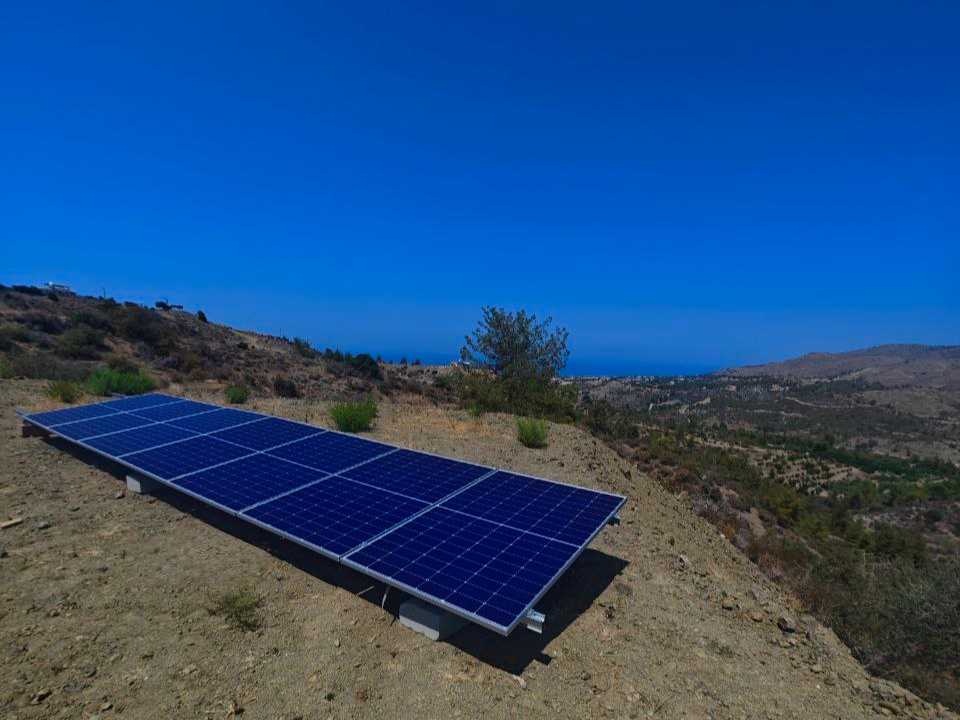
The solar panel array should be sized at 1.3 to 1.5 times the pump’s rated power. A 550W well pump needs around 750–820W of panels. A 1,500W surface pump needs around 2,000–2,250W. Panel voltage also has to fit the controller’s input range. We calculate the exact requirement during sizing.
5. Controller (MPPT technology)
Every solar pump system needs one. The controller sits between the panels and the pump and does two things: it extracts the maximum available power from the panels at any irradiance level, and it adjusts pump speed to match. When a cloud passes, the controller slows the pump rather than stopping it entirely. Without an MPPT controller, your pump would stop and start every time the sunlight changed — which is hard on the motor and bad for water delivery. All solar pumps in Cyprus that we supply from Hybsun include a separate MPPT controller that mounts above ground for easy access.
6. Storage tank or direct pumping?
Direct Pumping: Water is pumped directly as it’s needed, ideal for irrigation during sunny hours.
Storage Tank: Pumping water into a storage tank allows you to accumulate water during peak sun hours for use during the night or on cloudy days. This provides greater flexibility and reliability for domestic use or consistent irrigation. In Cyprus, where water can be a precious resource, a storage tank is often a wise investment.
7. Durability and material quality
Given Cyprus’s climate, with its intense summer heat and often high salinity in coastal areas, the materials and build quality of your solar pump are absolutely paramount. You need a system that’s built to last and withstand these challenging conditions. Look for solar pumps in Cyprus made from corrosion-resistant materials like stainless steel.
When evaluating a solar pump, pay close attention to the components and their construction. For instance, impellers – crucial for moving water – are often made from high-grade materials. You’ll typically find:
Stainless steel impellers: These are highly valued for their exceptional durability and resistance to corrosion, even in aggressive water conditions. Their robust nature ensures a longer lifespan for your pump and reduces the need for frequent replacements, providing consistent, efficient performance.
High-quality plastic impellers: Advancements in material science have led to specialized plastics that offer excellent cost-efficiency and reduced weight. This lighter design can lessen the load on the pump’s motor, potentially improving overall energy efficiency. They are also engineered to be resistant to corrosion and wear and tear, ensuring reliable operation across various water qualities.
Beyond impellers, look for pumps where key parts are constructed from 304 stainless steel for superior durability and protection against breakage. Internal components like bearings (e.g., Japanese NSK bearings) are critical for smooth operation and extended lifespan, while silicon carbide graphite seals enhance reliability and longevity by preventing leaks.
At CGP Solar, we understand these critical details. That’s why we ensure all these high-quality components and materials are included in our pumps. We meticulously select and stock only durable solar pumps in Cyprus residents can truly rely on, guaranteeing that the materials and craftsmanship meet the demanding environmental conditions of the island and deliver long-term value for your investment.
Proper sizing is crucial for optimal performance and cost-effectiveness. Here’s how to calculate your requirements:
Calculate daily water needs
Determine required flow rate
Divide your daily water needs by the hours of available sunlight (typically 6-8 hours in Cyprus). This gives you the minimum flow rate required.
Factor in system losses
Account for friction losses in pipes, elevation changes, and system inefficiencies. A general rule is to add 20-30% to your calculated requirements.
Consider peak demand
If you have periods of high water demand, ensure your system can handle peak flow requirements or consider water storage options.
Tell us about your water source, depth and usage and we’ll size the right pump and panel array — no obligation, just the honest recommendation.
One of the genuine advantages of solar pumps in Cyprus is how little servicing they need. Modern brushless-motor pumps have no consumable parts inside the motor itself. The basic schedule looks like this:
For ongoing care, our photovoltaic systems maintenance service covers solar pump installations alongside standard PV systems. Most customers, though, do their own monthly checks and only call us when something genuinely needs attention.
Reduced water flow: Often caused by dirty solar panels or clogged filters. Clean panels and replace filters as needed.
Pump won’t start: Check electrical connections, solar panel output, and controller settings. Ensure adequate sunlight is available.
Intermittent operation: May indicate loose connections or failing components. Contact a professional for diagnosis.
In a normal year, solar pumps in Cyprus are a smart way to reduce running costs and add a bit of energy independence. In 2026 — with reservoirs at record lows and electricity prices climbing — they’re closer to a practical necessity for anyone with a borehole, a pool, or land that needs irrigating.
Ready to explore your options? Visit our website to browse our complete selection of solar pumps in Cyprus residents trust. Our experienced team is here to help you choose the perfect system for your specific needs and budget.
For more information about renewable energy in Cyprus, visit the Cyprus Energy Regulatory Authority or the RES and Energy Conservation Fund for current incentive programs.
Take the first step toward energy independence and sustainable water pumping.
Contact CGP Solar today for a no-obligation consultation! Let us help you find the perfect solar water pumping solution that delivers consistent, cost-effective water for your home, farm, or business.
FAQ’s
Yes — and increasingly so. An irrigation pump that runs 6–10 hours a day during the growing season is one of the heaviest consumers of electricity (or diesel) on a typical Cyprus farm. A correctly sized solar pump removes that running cost almost entirely during daylight hours, which is also exactly when irrigation is most needed. For drip irrigation, sprinkler networks, olive groves, vineyards, citrus orchards and greenhouse operations, the payback period is often shorter than for any other type of solar pump installation we do. Send us your current pump size, daily run-time and electricity bill and we’ll give you a real number for your farm.
Yes. Drip irrigation actually pairs particularly well with solar pumping because both are designed for steady, lower-flow operation. The Hybsun surface and agricultural ranges deliver the head pressure (up to 55m) and flow rates that drip systems need, and the natural daytime rhythm of solar matches the optimal irrigation window before peak heat. For larger fields with multiple zones or sprinklers, we size the pump and panel array to your specific layout — there’s no one-size-fits-all answer.
That’s where the AC/DC hybrid agricultural pumps come in. They run on solar by default and switch automatically to grid or generator power when the sun isn’t available — so your irrigation schedule isn’t dependent on the weather. This is the typical specification for greenhouse operations, livestock watering, and any farm where irrigation timing is fixed. The hybrid costs more upfront than a solar-only DC pump but gives you 24/7 reliability.
A good-quality solar pump with a brushless DC motor and stainless steel construction will typically last 10 to 15 years in Cyprus conditions. The solar panels last 30+ years. The MPPT controller usually lasts 10–15 years. The single biggest factor in pump lifespan is correct sizing — a pump that’s working within its design range, not flat out at maximum capacity all day, lasts much longer than one that’s always at the limit.
Almost never. The simpler and cheaper alternative is either a DC pump with a storage tank (so you collect water during the day and use it whenever you need it) or an AC/DC hybrid pump (which uses the grid as backup when there’s no sun). Adding battery storage to a solar pump system is expensive and rarely necessary in Cyprus where grid backup or tank storage solves the same problem more cheaply.
All Hybsun solar pumps include dry-run protection as standard. If the water level in your well drops below the pump intake, the pump detects the change in current draw and shuts down automatically — usually within seconds. It then waits before attempting to restart. This protects the motor from overheating and is genuinely useful during a drought year when groundwater levels are low.
The Hybsun submersible range we stock covers boreholes up to 210 metres deep. That depth is well beyond what’s typical for residential boreholes in Cyprus (most are 50–150 metres) and covers most agricultural boreholes too. For very deep or specialised installations, we can specify multi-stage pumps designed for greater depths.
Yes, partially. The MPPT controller continuously adjusts pump speed to match available solar power. Under partial cloud, your pump runs slower and delivers reduced flow rather than stopping entirely. In heavy cloud or at night, a DC pump stops, a hybrid pump switches to grid or generator. This is exactly why a storage tank or hybrid setup is recommended if your water needs are time-critical.
Honestly, it depends on three things: how much you currently spend on electricity for water pumping, how many hours your pump runs per day, and the size of pump you need. A typical pool pump replacement saves enough to pay for itself within a few swimming seasons at current electricity prices. An irrigation pump replacement on a working farm pays back faster because the pump runs more hours. Send us your current electricity bill and pump details and we’ll give you a real number based on your actual situation.
Yes. Cyprus winters are mild and sunny enough that solar pumps generally keep working through the cooler months — at reduced output, since the days are shorter. Pool pumps often run reduced schedules in winter anyway. For year-round agricultural irrigation or domestic supply, a hybrid pump or a properly sized storage tank handles the seasonal dip.
For pumping water from your own private borehole, you typically already have a Water Development Department borehole permit (the borehole couldn’t have been drilled legally without one). The solar pump itself doesn’t add new permitting requirements in most cases. For ground-mounted solar arrays larger than 20 m², you may need a building permit depending on your municipality. We help customers understand what’s required for their specific situation.
Yes. The new pump goes where the old one was, the panels mount nearby, and the controller wires it all together. Replacing an existing well pump is straightforward — we lift the old one out and lower the new one in. Replacing a pool pump is even simpler, often a same-day job. Send us a photo of your current setup and we’ll tell you what’s involved.
You can see the full Hybsun range at our showroom in Paphos (Alexandrou Papagou Avenue 65). We also have project case studies on our solar pump installations page showing real installations across Cyprus. For a hands-on demonstration or to check current stock, give us a call.
